What's Happening
Welch's has entered the frozen sandwich aisle with Real PB&Js, announced July 13. The individually wrapped 3.1oz sandwiches carry 12g of protein, qualify as a good source of fiber, and are built with fresh-baked bread, creamy peanut butter, and the company's own fruit spreads. Welch's markets them as 50% bigger than the leading national brand's 2oz sandwich, with twice the protein.
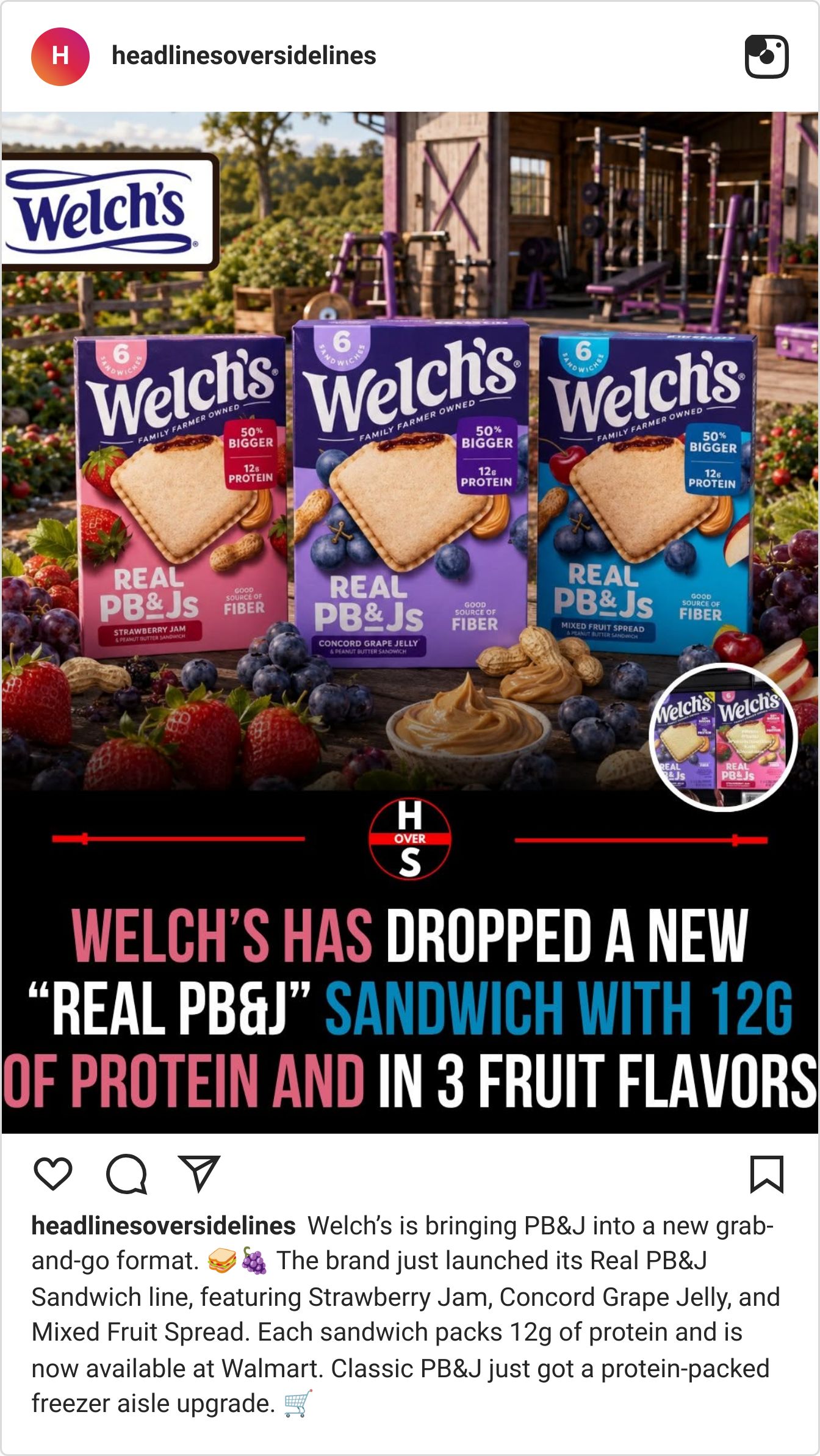
Three flavors launch: Concord Grape Jelly, Strawberry Jam, and an entirely new Mixed Fruit spread made from cherries, apples, and grapes, inspired by the brand's Fruit Snacks. The sandwiches contain no artificial colors and no high fructose corn syrup. They ship in six-count boxes at a suggested $8.87, rolling out now exclusively at select Walmart stores nationwide before expanding to additional retailers in 2027. They are not currently listed on Walmart.com, and Welch's runs a store finder at welchsrealpbjs.com since stock is not guaranteed.
The protein sourcing is the detail that separates this from most of the category. Welch's states plainly that the 12g comes naturally from real ingredients like peanuts, with no synthetic or added proteins and no isolates. This is not a fortified product. It is a bigger sandwich with more peanut butter in it, and the rest of the panel reflects that: each sandwich carries 18g of fat, 38g of total carbohydrates with 13g of sugar (only 4g of it added), and 350 to 360 calories.
"When we asked what consumers would want from a PB&J if we were creating it today, the answer was surprisingly simple," said Andrew Hartshorn, chief brand and innovation officer at Welch's. "They wanted a bigger sandwich for bigger appetites, one that actually fills them up."
Practical notes: the sandwiches thaw in 30 to 60 minutes, hold up to 10 hours unrefrigerated once thawed, and should never be refrozen. They contain peanuts and wheat, are made in a facility that also handles hazelnuts, milk, and soy, and are not gluten free.
Why It Matters
Welch's is attacking a category J.M. Smucker has owned outright. Uncrustables cleared more than $1 billion in annual sales in fiscal 2026, sold in 4-count boxes of 2oz sandwiches with 6g of protein each. Welch's answer is simply more sandwich: 3.1oz against 2oz, 12g of protein against 6g. At $8.87 for six, that works out to roughly $1.48 per sandwich, or about 48 cents an ounce, which undercuts Jams on a per-ounce basis despite the larger format.
The "no isolates" positioning is a real strategic wedge. Most of the protein snacks flooding shelves right now get their numbers from whey, milk, or pea isolate, and a meaningful slice of shoppers has grown skeptical of that. Welch's is betting there is room for a product that hits a respectable protein number through food rather than fortification, and leans on 150-plus years of brand trust to sell it.
The tradeoff is the part Welch's does not advertise. Protein from peanut butter arrives with the fat and calories peanut butter carries, and at 350 to 360 calories with 18g of fat, a Real PB&J is a genuine meal-sized item rather than a light snack. Set against a 2oz Uncrustable, it delivers twice the protein but roughly 50% more calories, so the protein-per-calorie math barely moves. Welch's promotes protein and fiber on its packaging and product site but does not publish a full nutrition panel there, and with no Walmart.com listing yet, shoppers cannot easily check the macros before they buy. Anyone treating this as a lean protein snack rather than a full-size PB&J should read the label in the freezer aisle.
Bigger Picture
The frozen PB&J has become one of the most crowded fights in packaged food. Jams, backed by Alex Morgan, CJ Stroud, and the Poppi founders, moved into Walmart and Target last fall with 2.7oz crustless sandwiches at 10g of protein. Kraft Heinz launched Lunchables PB&J in May 2025 at 6g of protein. Fave'Wich went nut-free with sunflower butter SB&Js. Rudi's took the gluten-free lane with Sandos. Smucker's spent this spring reformulating Uncrustables to be fridge friendly, an unmistakable defensive move.
What all of it has in common is a bet that the lunchbox staple is a functional-food opportunity in disguise. The PB&J was never engineered; it was assembled by parents for decades. Now every player is trying to find the version worth paying a premium for, whether that premium is protein, size, convenience, or allergen safety.
Welch's has the most distinctive answer of the bunch, because it is the only one arguing the classic sandwich was mostly right and just needed to be bigger. Whether shoppers reward that or drift toward the leaner, isolate-fortified options will say a lot about how much the protein boom is about the number on the box versus what the food actually is.
Sources
Welch's (PR Newswire) - https://www.prnewswire.com/news-releases/welchs-introduces-new-real-pbjs-to-the-freezer-aisle-302823863.html
Welch's Real PB&Js - https://www.welchsrealpbjs.com/
Food Business News - https://www.foodbusinessnews.net/articles/30670-welchs-joins-frozen-sandwich-fight