What's Happening
Oura revealed the Oura Ring 5 on May 28, opening pre-orders the same day with shipping set to begin June 4. The launch caught the industry off guard as recent rumors had pegged the next Oura ring for a late 2027 release. Instead, the market leader moved early with what it's calling the world's smallest smart ring.
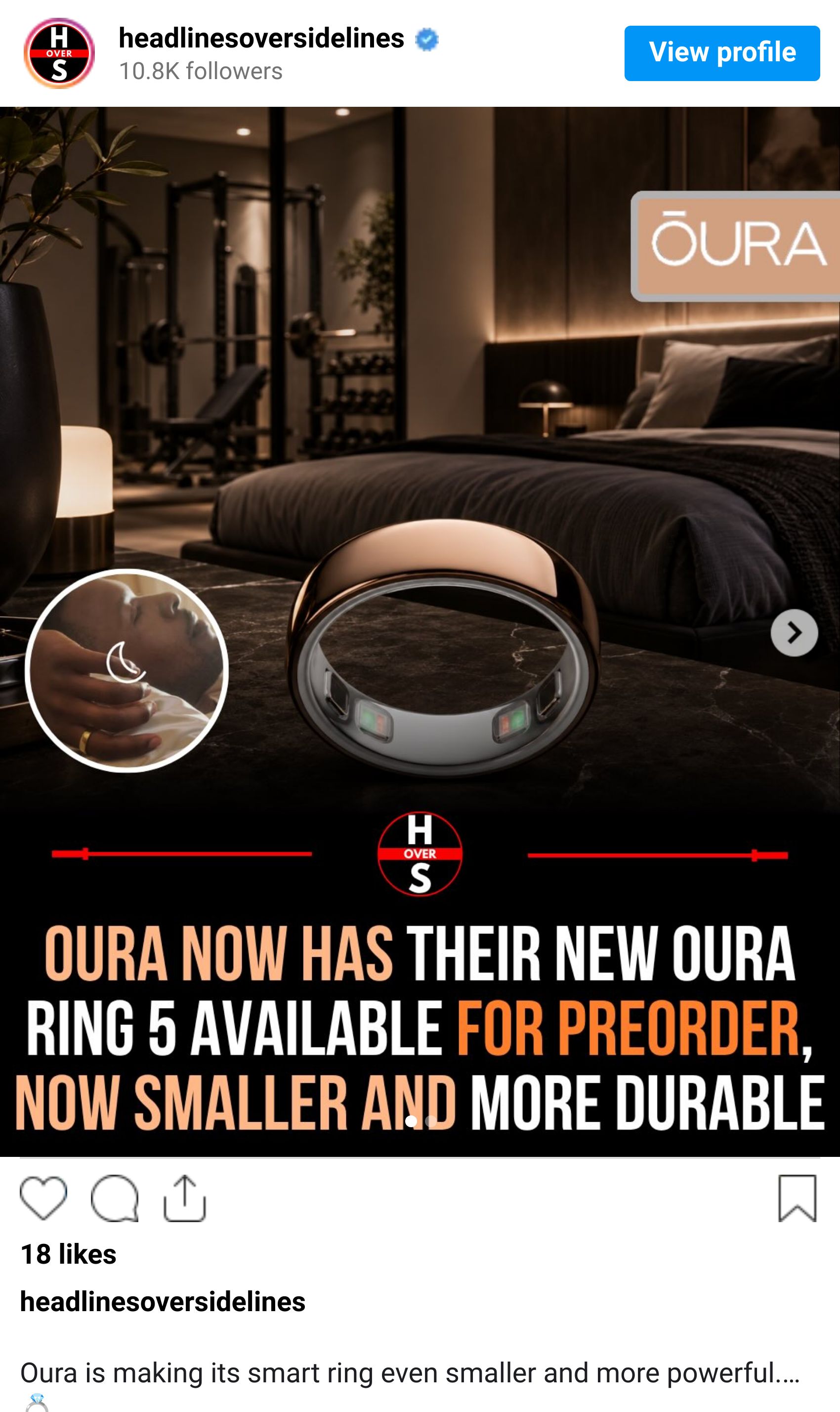
The Ring 5 is roughly 40% smaller than the Ring 4, measuring 6.09 mm wide and 2.28 mm thick. Oura says it didn't just shrink the device but re-engineered it from the ground up, with a redesigned sensing architecture, low-profile sensor domes for better skin contact, and 12 signal pathways meant to improve accuracy across different finger types and skin tones. The company claims a pulse signal up to 100 times stronger than wrist-based wearables. Battery life runs six to nine days, and the ring is built from scratch-resistant titanium with a stronger coating and 100-meter (IP68) water resistance.
It comes in six finishes and starts at $399 for Silver and Black, rising to $499 for premium options (Gold, Deep Rose, Brushed Silver, and Stealth). An optional matchbox-sized Charging Case adds up to a month of portable power. Oura Membership remains $5.99/month or $69.99/year. The ring is available at ouraring.com and through Amazon, Best Buy, Costco, Target, and Walmart. Because the ring is so much smaller, Oura is urging even existing owners to order a new sizing kit before buying.
Alongside the hardware, Oura is rolling out a new software suite available to Gen 3 rings and newer, not just the Ring 5 including Health Radar with overnight blood pressure signals, GLP-1 Insights, lab result uploads, live activity tracking, and AI-enabled medical guidance through a partnership with Counsel Health. Several of these features are launching first in the US, India, and the UAE starting in June.
Why It Matters
The headline isn't really the smaller size, it's the timing and the software. By launching nearly a year ahead of expectations, Oura is moving to defend its lead before competitors like Samsung's Galaxy Ring and Ultrahuman close the gap. The smart ring category has gotten crowded fast, and Oura's strategy here is to widen the gap on two fronts at once: a hardware size advantage that's hard to replicate, and a software ecosystem that turns the ring from a tracker into something closer to a health platform.
The blood pressure and AI-care features are the most consequential part of the announcement. Overnight blood pressure tracking and AI-enabled medical guidance push Oura out of the wellness-gadget lane and toward genuine preventative health territory — a space with far bigger stakes, and far more regulatory complexity. Rolling those features out gradually and region by region reflects how carefully Oura has to tread when it starts making health claims that edge toward the medical.
Bigger Picture
The fact that Oura's new software works on three-year-old hardware is a strategic tell. The company is leaning into its membership-driven model, where recurring subscription revenue matters as much as device sales. Giving older rings access to Health Radar and GLP-1 Insights keeps the existing base subscribed while the smaller, more comfortable Ring 5 expands the funnel to new users who found previous rings too bulky.
It also lands squarely in the year's biggest health-tech themes. GLP-1 Insights ties Oura directly to the Ozempic-era wave of metabolic-health interest, blood pressure tracking targets one of the most common chronic conditions in the world, and AI-enabled care reflects the broader rush to put a medical co-pilot in consumers' pockets. Oura is betting that the future of wearables isn't about counting steps — it's about predicting and managing real health outcomes, and the Ring 5 is the smallest, most wearable vehicle yet for that bet.
Sources
Business Wire: ŌURA Introduces The World's Smallest Smart Ring: Oura Ring 5
Tech Advisor: Oura Ring 5: Release Date, Price & Specs