What's Happening
Mason Wright, a Salt Lake City ultrarunner known online as “Buff Runner,” completed a 1,000-mile run around a track at Layton High School in Utah, finishing the challenge in 18 days, 13 hours, and 11 minutes.
The effort required Wright to complete roughly 4,000 laps on a standard quarter-mile track while averaging approximately 53.7 miles per day across nearly three weeks.
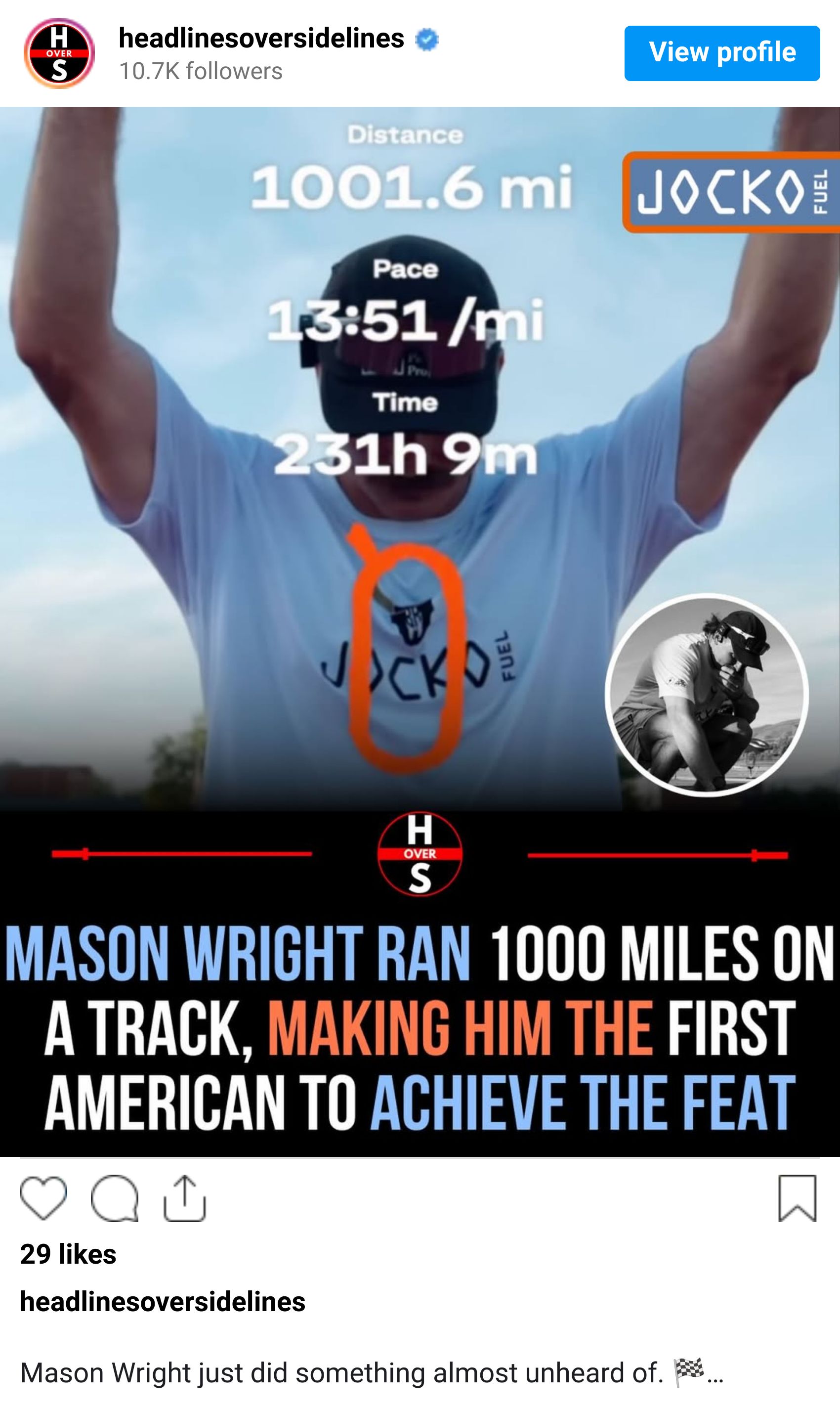
Wright reportedly ran daily from around 5 a.m. until 8 p.m., taking only short breaks for food, hydration, physiotherapy, massage work, and medical treatment. By the halfway point of the challenge, he was dealing with nerve damage in his legs and feet, though he continued through the pain until completion.
The run was organized as a fundraiser for The Single Parent Project, a nonprofit supporting single-parent families. Wright has said the cause is deeply personal because he was raised by a single mother and wanted to help provide opportunities for children growing up in similar situations.
According to Running Magazine, Wright became the first American and only the third person ever to complete a 1,000-mile track challenge of this nature, joining a very small group that includes ultrarunning legend Yiannis Kouros and Australian endurance athlete Nedd Brockmann.
This was not Wright’s first extreme endurance project. In 2025, he completed a 421-mile run across Utah, which he later described as preparation for the 1,000-mile challenge.
Why It Matters
This challenge highlights the growing cultural fascination with extreme endurance and multi-day ultrarunning, where the focus has shifted from pure speed toward resilience, durability, and mental toughness.
Unlike traditional races with changing scenery and competition dynamics, track ultras are considered especially punishing because of the repetition and monotony involved. Athletes face not only physical breakdown from extreme mileage, but also the psychological strain of staring at the same environment for days at a time.
Wright’s effort also reflects a broader trend where endurance athletes are using large-scale physical challenges as fundraising and storytelling platforms. Similar projects from athletes like Nedd Brockmann have shown how extreme endurance events can generate major engagement and charitable support far beyond traditional racing audiences.
Social media has amplified this shift significantly. Multi-day endurance challenges now function as ongoing narratives that audiences follow in real time, turning ultrarunners into creators, motivators, and community builders rather than just competitors.
From a performance standpoint, the challenge also demonstrates how far ultrarunning has evolved. Recovery protocols, pacing strategies, nutrition, and mental conditioning are allowing athletes to sustain workloads that once seemed impossible, even in highly repetitive environments like a running track.
Bigger Picture
Ultrarunning continues to grow from a niche endurance discipline into a mainstream performance and lifestyle movement centered around pushing human limits.
Challenges like Wright’s 1,000-mile run reflect how endurance sports are increasingly blending athletic performance, social storytelling, fundraising, and community engagement into a single experience.
Sources
Running Magazine – https://runningmagazine.ca/the-scene/this-u-s-ultrarunner-just-ran-1000-miles-around-a-track/
Marathon Handbook – https://marathonhandbook.com/american-ultrarunner-mason-wright-logs-1000-miles-around-a-utah-high-school-track/