What's Happening
SOND, a Boston-based sleep-tech startup, has launched pre-orders for its debut product, Dreambuds, through a Kickstarter campaign. Unlike most sleep earbuds that simply mask noise or play calming audio, Dreambuds are built to actively intervene, capturing 12 physiological signals from the wearer and responding in real time to help them fall asleep faster and stay asleep longer.
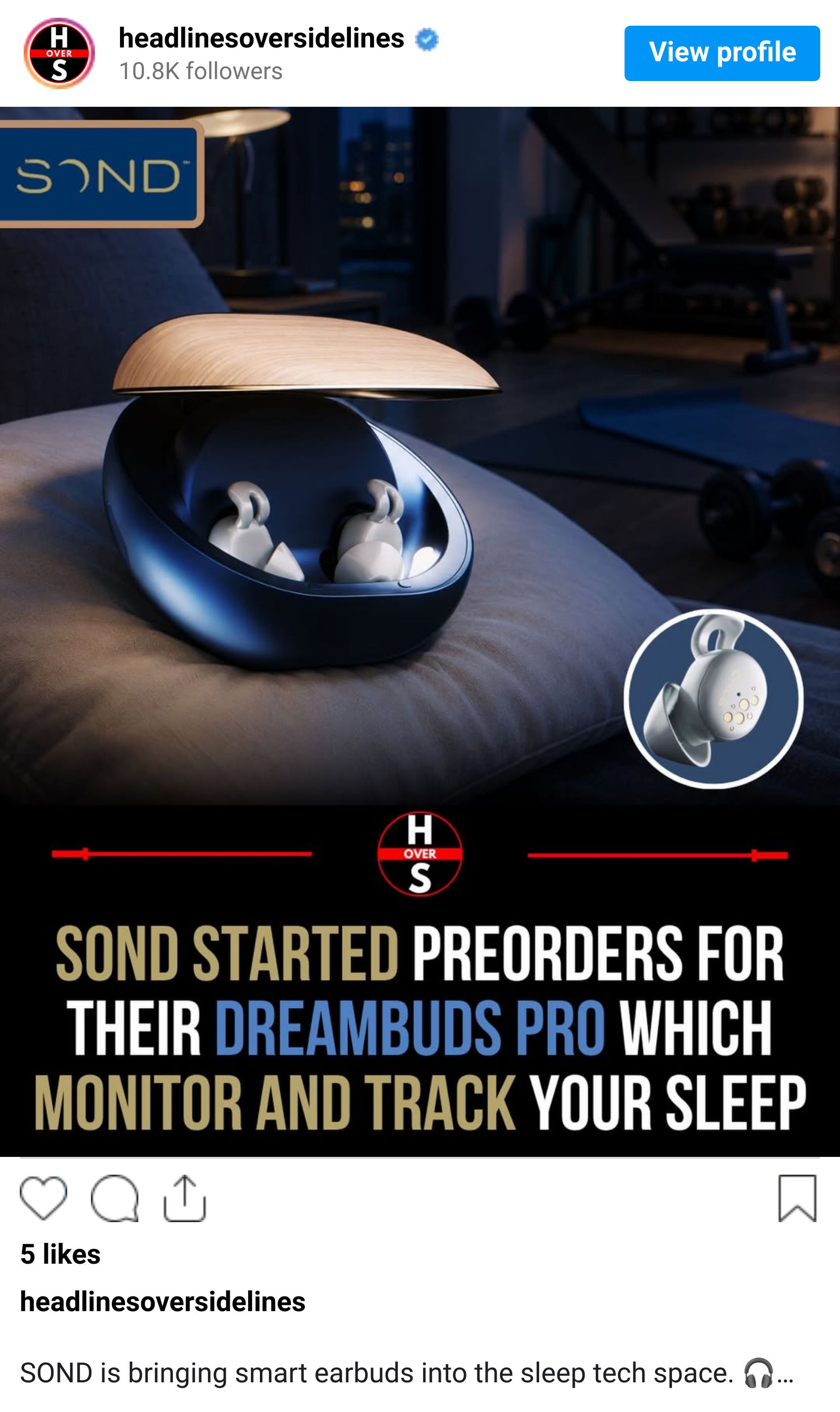
The buds track signals including respiration, heart rate variability, cardiorespiratory coupling, sleep staging, body position, snoring, and seismocardiography (the mechanical vibrations of the chest wall from the beating heart). That data streams to a cloud-based AI sleep coach that selects or generates a custom audio program from a library of more than 500 options like soundscapes, sleep-music tracks, breathing exercises, binaural beats, or generated sleep stories and learns over time what works for each user. The system runs without a phone: the charging case has Wi-Fi, Bluetooth, an OLED display, physical buttons, and a speaker, so users control everything from the case and earbuds themselves. The AI coach only speaks when prompted with a double-tap.
Dreambuds launched with an early-bird price of $449, against an expected retail price of $650, with no subscription fees. The company emerged from stealth in late May with $7 million in funding from backers including the MIT-affiliated E14 Fund, Crosslink Capital, Ubiquity Ventures, Alumni Ventures, Meach Cove Capital, and Boston Scientific co-founder John Abele. SOND aims to reach mass production by the second half of 2026.
Why It Matters
The pedigree is the headline here. SOND was co-founded by CEO Yadid Ayzenberg, who previously served as Bose's Head of Sleep Products and launched the Bose Sleepbuds 2, alongside CTO Amir Lazarovich, a former senior engineering manager at Google. When Bose exited the sleep business, Ayzenberg saw an opening to build the product Bose customers kept asking for: sleepbuds with sensors that don't just track sleep but improve it. That makes Dreambuds less a startup gamble and more a continuation of work that a major audio brand walked away from.
The "closed-loop" concept is the real differentiator. Wearables like Oura and Apple Watch track sleep and report back in the morning; Dreambuds are designed to respond at 2 a.m., adjusting audio while the user is still asleep. The phone-free design directly targets a real behavioral problem as Ayzenberg jokes that giving an insomniac a phone is like running an AA meeting in a liquor store. By keeping all controls on the device, SOND is betting it can break the middle-of-the-night phone-checking cycle that undermines sleep in the first place.
Bigger Picture
Dreambuds enter a sleep-tech market that's getting crowded fast, but from an unusual angle. Most competition is split between sleep trackers (Oura, Whoop, Apple) and passive sleep earbuds (Ozlo, Soundcore). SOND is trying to merge the two and add active intervention on top with a more ambitious pitch that, if it works, could define a new product category rather than competing in an existing one.
The open questions are the ones every hardware startup faces, amplified by the premium price. At $449 early and $650 at retail, Dreambuds cost far more than most sleep wearables, and the company still has to prove that sensor-packed earbuds are comfortable enough to wear all night, that the battery lasts, and that the AI coaching genuinely improves sleep rather than just feeling novel. Those answers won't come until real users live with the device beyond beta tests. The crowdfunding model is a deliberate hedge as investor money funded the design and testing, and Kickstarter pre-orders fund manufacturing while gauging real demand before mass production. It's a sign of serious pedigree meeting unproven real-world performance, and the next few months will reveal which one wins out.